 Add to Chrome
 Add to Firefox
 Add to Edge
Combinatorial Synthesis: Scaling Code RLVR via Atomic Decomposition and Recombination
May 29, 2026
Reinforcement Learning with Verifiable Rewards (RLVR) has recently emerged as the cornerstone for shaping the remarkable coding abilities of Large Language Models (LLMs). However, the scalability of RLVR is severely constrained by the scarcity of sufficiently challenging verifiable code tasks that target near the model's edge of competence. Prior studies often rely on heuristic seed expansions for data synthesis, which severely limits both novelty and difficulty. Consequently, the training value of such data fails to scale proportionally with the size of its synthesis. To this end, we propose Atomic Decomposition and Recombination (ADR), a novel framework that generates verifiable code tasks via decomposition into atomic elements and controlled recombination, thereby enabling the generation of genuinely novel and challenging verifiable code tasks. Experiments and analysis demonstrate that ADR achieves superior originality, difficulty, diversity, and test quality over existing baselines, and consistently delivers greater improvements in code ability across RLVR in diverse downstream domains, including algorithmic programming, tool usage, and data science. Our work sheds light on a new paradigm for novel code task synthesis and scalable RLVR training.

LiteCoder-Terminal: Scaling Long-Horizon Terminal Environments for Learning Language Agents
May 28, 2026Mastering terminal environments requires language agents capable of multi-step planning, feedback-grounded execution, and dynamic state adaptation. However, training such agents is currently bottlenecked by a reliance on scraped external repositories, which limits domain diversity, environment controllability, and the targeting of specific capability deficits. We introduce LiteCoder-Terminal-Gen, a zero-dependency synthesis pipeline that autonomously generates executable and verifiable terminal training environments directly from domain specifications. Using this framework, we construct two large-scale resources: LiteCoder-Terminal-SFT, comprising 11,255 expert trajectories across 10 domains, and LiteCoder-Terminal-RL, featuring 602 verifiable environments for trajectory-level preference optimization. Supervised fine-tuning of Qwen-family models on our SFT dataset yields agents that significantly outperform their base counterparts. Notably, our 32B variant achieves 29.06%, 18.54%, and 34.00% pass@1 on Terminal Bench 1.0, 2.0, and Pro, respectively. Furthermore, applying Direct Multi-turn Preference Optimization (DMPO) on our RL environments yields additional performance gains. These results systematically demonstrate that fully synthetic, executable environments offer a scalable and verifiable supervision signal for mastering complex, real-world command-line workflows.
MetaphorVU: Towards Metaphorical Video Understanding
May 25, 2026Metaphorical videos are prevalent across various real-world scenarios to convey complex ideas, and understanding them typically requires high-order cognitive capabilities. The lack of systematic studies on metaphorical video understanding not only constrains the real-world applicability of MLLMs but also impedes the thorough assessment of their high-order cognitive capabilities. To bridge this gap, we propose MetaphorVU-Bench, the first systematic and comprehensive benchmark dedicated to metaphorical video understanding. Through experiments, we find current MLLMs struggle with accurate metaphorical video understanding, lagging far behind human level, primarily due to defective cross-domain mapping. Motivated by this finding, we construct a metaphor knowledge graph as mapping augmentation and propose MetaphorBoost, an inference-time enhancement framework achieving consistent performance improvement. Our benchmark, analysis, and method provide useful insights and a foundation for future research on advancing MLLMs.
Learning from Failures: Correction-Oriented Policy Optimization with Verifiable Rewards
May 14, 2026Reinforcement Learning with Verifiable Rewards (RLVR) has emerged as an effective paradigm for improving the reasoning capabilities of large language models. However, RLVR training is often hindered by sparse binary rewards and weak credit assignment, resulting in ambiguous optimization signals and underutilization of the useful information embedded in failed trajectories. To address this challenge, we propose Correction-Oriented Policy Optimization (CIPO), a simple and effective extension to RLVR that converts on-policy failed trajectories into correction-oriented supervision, without relying on any external signals. By jointly optimizing correction samples derived from the model's own failed attempts together with the standard RLVR objective, CIPO improves learning effectiveness while explicitly enhancing the model's ability to correct its own errors. Extensive experiments across 11 benchmarks spanning mathematical reasoning and code generation demonstrate that CIPO consistently and significantly outperforms strong baselines in both reasoning and correction performance. Moreover, CIPO yields stronger pass@K gains, indicating that it improves the model's intrinsic reasoning capacity rather than merely redistributing probability mass over existing correct answers.
All Languages Matter: Understanding and Mitigating Language Bias in Multilingual RAG
Apr 22, 2026Multilingual Retrieval-Augmented Generation (mRAG) leverages cross-lingual evidence to ground Large Language Models (LLMs) in global knowledge. However, we show that current mRAG systems suffer from a language bias during reranking, systematically favoring English and the query's native language. By introducing an estimated oracle evidence analysis, we quantify a substantial performance gap between existing rerankers and the achievable upper bound. Further analysis reveals a critical distributional mismatch: while optimal predictions require evidence scattered across multiple languages, current systems systematically suppress such ``answer-critical'' documents, thereby limiting downstream generation performance. To bridge this gap, we propose \textit{\textbf{L}anguage-\textbf{A}gnostic \textbf{U}tility-driven \textbf{R}eranker \textbf{A}lignment (LAURA)}, which aligns multilingual evidence ranking with downstream generative utility. Experiments across diverse languages and generation models show that LAURA effectively mitigates language bias and consistently improves mRAG performance.
Towards Real-world Human Behavior Simulation: Benchmarking Large Language Models on Long-horizon, Cross-scenario, Heterogeneous Behavior Traces
Apr 09, 2026The emergence of Large Language Models (LLMs) has illuminated the potential for a general-purpose user simulator. However, existing benchmarks remain constrained to isolated scenarios, narrow action spaces, or synthetic data, failing to capture the holistic nature of authentic human behavior. To bridge this gap, we introduce OmniBehavior, the first user simulation benchmark constructed entirely from real-world data, integrating long-horizon, cross-scenario, and heterogeneous behavioral patterns into a unified framework. Based on this benchmark, we first provide empirical evidence that previous datasets with isolated scenarios suffer from tunnel vision, whereas real-world decision-making relies on long-term, cross-scenario causal chains. Extensive evaluations of state-of-the-art LLMs reveal that current models struggle to accurately simulate these complex behaviors, with performance plateauing even as context windows expand. Crucially, a systematic comparison between simulated and authentic behaviors uncovers a fundamental structural bias: LLMs tend to converge toward a positive average person, exhibiting hyper-activity, persona homogenization, and a Utopian bias. This results in the loss of individual differences and long-tail behaviors, highlighting critical directions for future high-fidelity simulation research.
P^2O: Joint Policy and Prompt Optimization
Mar 23, 2026Reinforcement Learning with Verifiable Rewards (RLVR) has emerged as a powerful paradigm for enhancing the reasoning capabilities of Large Language Models (LLMs). However, vanilla RLVR suffers from inefficient exploration, particularly when confronting "hard samples" that yield nearzero success rates. In such scenarios, the reliance on sparse outcome rewards typically results in zero-advantage estimates, effectively starving the model of supervision signals despite the high informational value of these instances. To address this, we propose P^2O, a novel framework that synergizes Prompt Optimization with Policy Optimization. P^2O identifies hard samples during training iterations and leverages the GeneticPareto (GEPA) prompt optimization algorithm to evolve prompt templates that guide the model toward discovering successful trajectories. Crucially, unlike traditional prompt engineering methods that rely on input augmentation, P^2O distills the reasoning gains induced by these optimized prompts directly into the model parameters. This mechanism provides denser positive supervision signals for hard samples and accelerates convergence. Extensive experiments demonstrate that P^2O not only achieves superior performance on in-distribution datasets but also exhibits strong generalization, yielding substantial improvements on out-of-distribution benchmarks (+4.7% avg.).
Decoupling Reasoning and Confidence: Resurrecting Calibration in Reinforcement Learning from Verifiable Rewards
Mar 10, 2026Reinforcement Learning from Verifiable Rewards (RLVR) significantly enhances large language models (LLMs) reasoning but severely suffers from calibration degeneration, where models become excessively over-confident in incorrect answers. Previous studies devote to directly incorporating calibration objective into existing optimization target. However, our theoretical analysis demonstrates that there exists a fundamental gradient conflict between the optimization for maximizing policy accuracy and minimizing calibration error. Building on this insight, we propose DCPO, a simple yet effective framework that systematically decouples reasoning and calibration objectives. Extensive experiments demonstrate that our DCPO not only preserves accuracy on par with GRPO but also achieves the best calibration performance and substantially mitigates the over-confidence issue. Our study provides valuable insights and practical solution for more reliable LLM deployment.
Memorizing is Not Enough: Deep Knowledge Injection Through Reasoning
Apr 01, 2025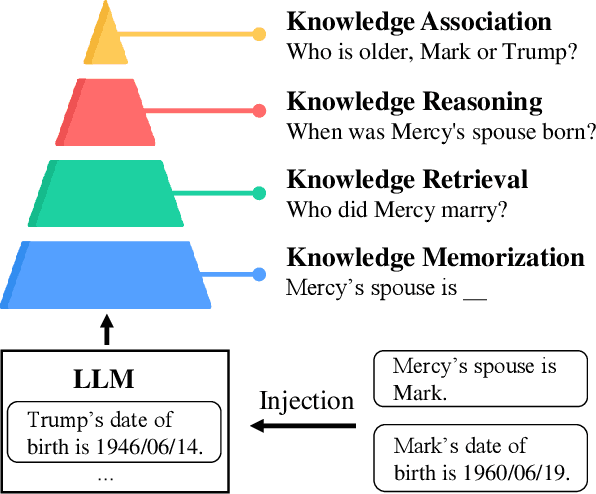
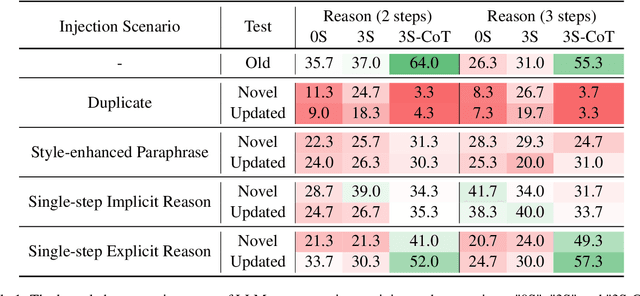
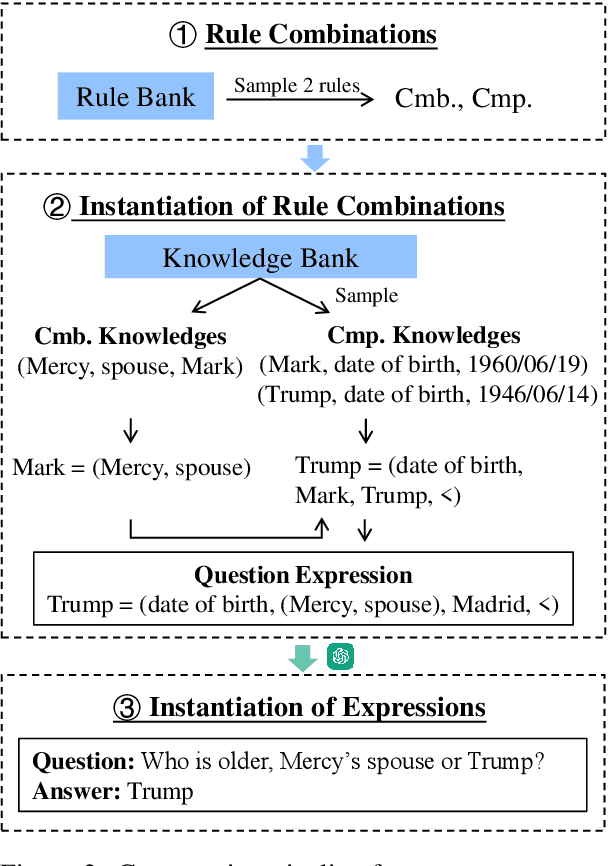
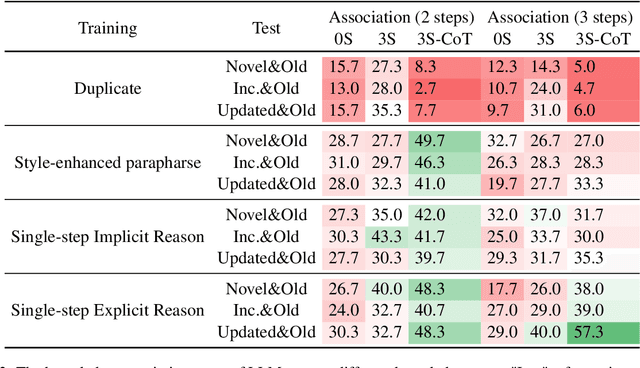
Although large language models (LLMs) excel in knowledge recall and reasoning, their static nature leads to outdated information as the real world evolves or when adapting to domain-specific knowledge, highlighting the need for effective knowledge injection. However, current research on knowledge injection remains superficial, mainly focusing on knowledge memorization and retrieval. This paper proposes a four-tier knowledge injection framework that systematically defines the levels of knowledge injection: memorization, retrieval, reasoning, and association. Based on this framework, we introduce DeepKnowledge, a synthetic experimental testbed designed for fine-grained evaluation of the depth of knowledge injection across three knowledge types (novel, incremental, and updated). We then explore various knowledge injection scenarios and evaluate the depth of knowledge injection for each scenario on the benchmark. Experimental results reveal key factors to reach each level of knowledge injection for LLMs and establish a mapping between the levels of knowledge injection and the corresponding suitable injection methods, aiming to provide a comprehensive approach for efficient knowledge injection across various levels.
Search, Verify and Feedback: Towards Next Generation Post-training Paradigm of Foundation Models via Verifier Engineering
Nov 18, 2024
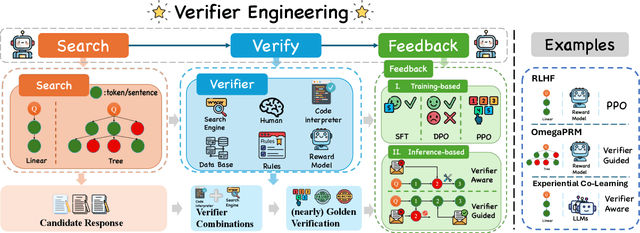

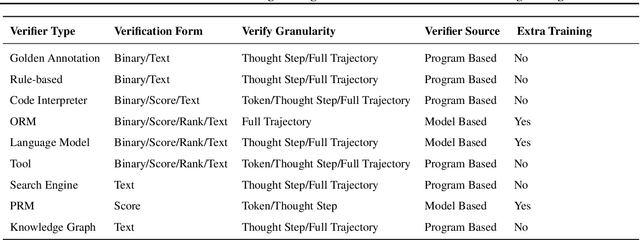
The evolution of machine learning has increasingly prioritized the development of powerful models and more scalable supervision signals. However, the emergence of foundation models presents significant challenges in providing effective supervision signals necessary for further enhancing their capabilities. Consequently, there is an urgent need to explore novel supervision signals and technical approaches. In this paper, we propose verifier engineering, a novel post-training paradigm specifically designed for the era of foundation models. The core of verifier engineering involves leveraging a suite of automated verifiers to perform verification tasks and deliver meaningful feedback to foundation models. We systematically categorize the verifier engineering process into three essential stages: search, verify, and feedback, and provide a comprehensive review of state-of-the-art research developments within each stage. We believe that verifier engineering constitutes a fundamental pathway toward achieving Artificial General Intelligence.